
Interview by Viola Wells
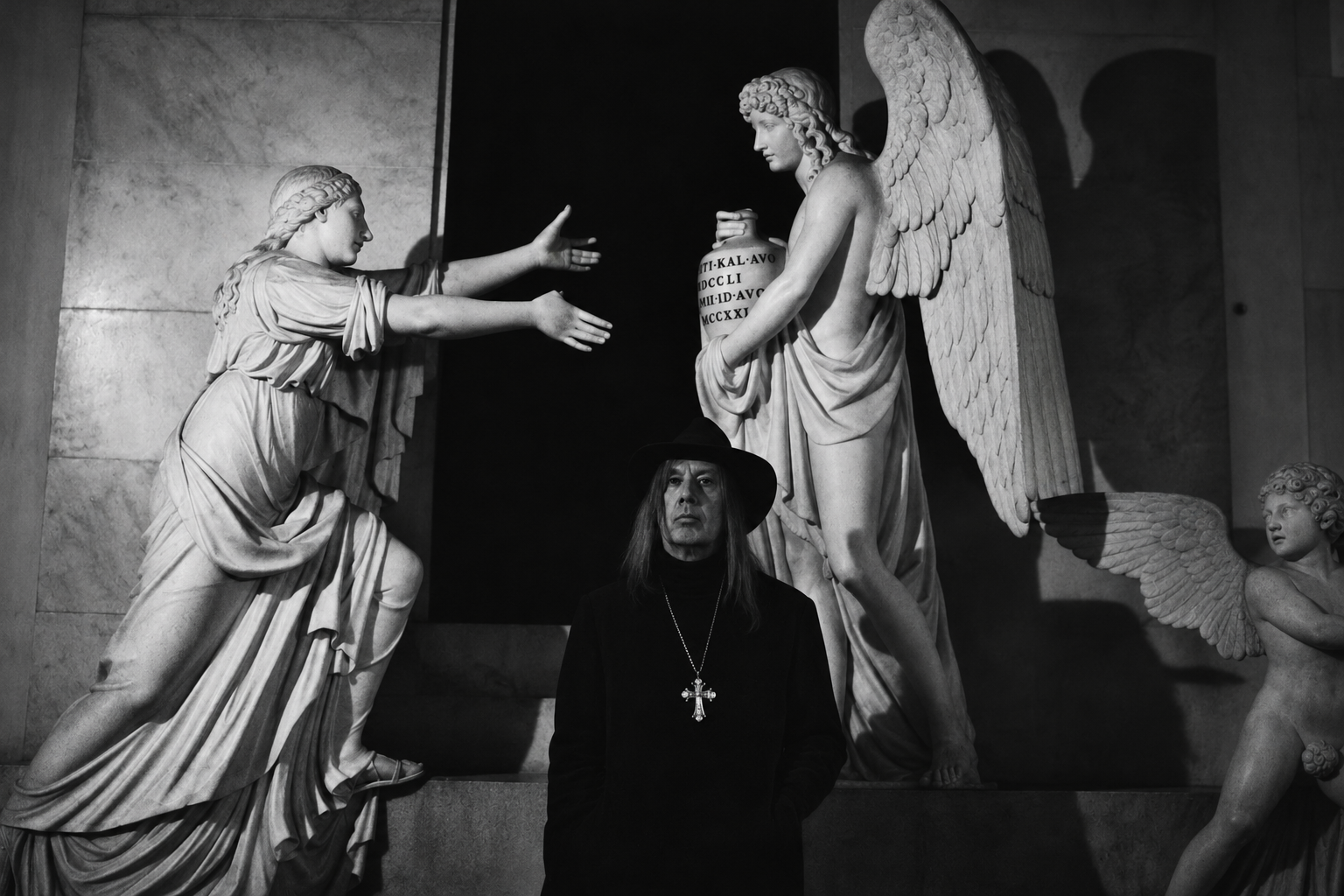
Photo by Manuel D’estro
In the midst of a world seemingly falling apart, there are still a few things that hold it together. Music, conversation, art — all of which lead us back to perhaps the most important aspect of our existence: connection. Connecting to our past, our psyche and one another; through sound, through contemplation of death, nature or art. I was fortunate enough to spend some time with Jozef van Wissem before his live performance, which made the conversation that followed less of an exercise in collecting facts and more of a stream of consciousness — personal, philosophical and occasionally meandering, much like the music itself.
A Dutch avant-garde composer and lutenist, van Wissem has spent much of his career challenging the conventions surrounding an instrument traditionally associated with Renaissance and Baroque music, bringing it into an entirely different sonic territory through experimental compositions. His musical explorations have also found a natural counterpart in cinema, particularly through his long-standing friendship and creative collaboration with filmmaker Jim Jarmusch. Having first met in New York in 2006, the two developed a shared musical language that eventually found its way onto several recordings and into Jarmusch's films, including Only Lovers Left Alive, for which van Wissem received the Soundtrack Award at the 2013 Cannes Film Festival. Their creative partnership continues to evolve, with two new records, Bocca di Lupo and Mouth of the Wolf, released this November through Sacred Bones Records. While the former explores dark, hypnotic compositions, spoken poetry and collaborative vocals, the latter ventures into expansive, guitar-driven instrumental territory.
Jozef van Wissem's performance took place on Halloween night, in the heart of Budapest, accompanying a screening of F. W. Murnau's 1922 silent film Nosferatu. I went alone, yet there was something about the atmosphere that made it feel as though everyone in the room belonged together. There's something to be said about the thinning of the veil on a moody autumn evening, listening to Jozef's haunting lute, at times gentle and spacious, at others corrosive and sharp. The story and imagery of Nosferatu seemed to welcome his compositions like no other interpretation I've encountered. As Ellen's world descended into devastation, Jozef's repetitive melodies returned again and again, each time carrying a little more distortion, a little more darkness.
Whether closing one's eyes at the cinema is sacrilegious or not, I found myself drifting inward, sitting in complete darkness and allowing the lute to guide my thoughts and visions. For a moment, the film became something less to be watched than experienced — a meeting point between image, sound and whatever was unfolding in my own mind.
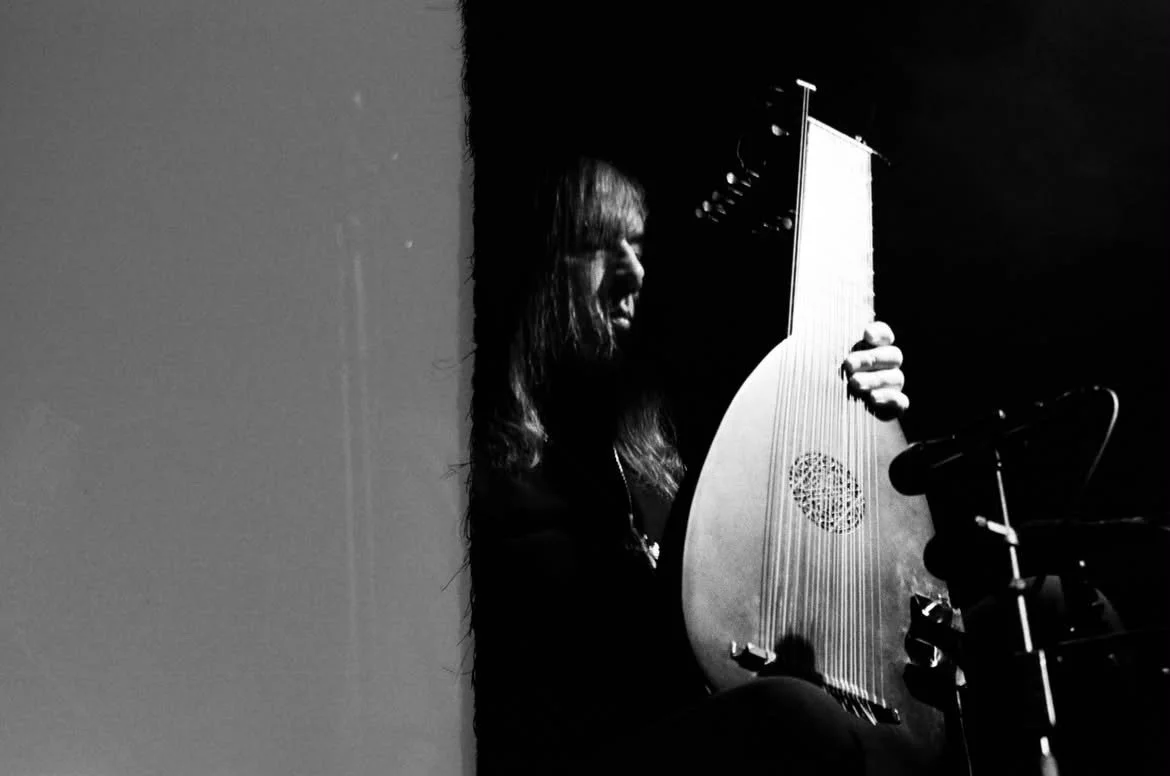
Photo credit: Arian Gharehbaghi
Viola Wells: I was wondering what you first felt when you picked up a lute. Did you feel an instant connection with the sound, with the feel of it?
Jozef van Wissem: When I was 14, I had a classical guitar teacher and saw a lute in her house, but she was hiding it from me. So I was intrigued.
When I moved to New York I saw an ad in the Village Voice for a lute teacher, Pat O'Brien, a student of Reverend Gary Davis. He was more open to teaching somebody coming from new wave or electric guitar, and explaining and teaching it that way. I tried doing it in Europe at The Hague Conservatory, and I had one lesson and I just left. What I like about it is that it's difficult to master.
V: Would you be comfortable saying, “Oh, I've mastered it now, I'm done,” or do you always want to learn more? Is there a way to learn more?
J: You can always learn more because there are different instruments, there are different lutes with different tunings. And now somebody also built a theorbo for me, which is almost two-metres long. It has a foldable neck, so it's huge, and it has a different tuning, reentrant tuning. Also there exists a lot of solo lute repertoire, which I keep playing at home as an inspiration for my work. So you will never master everything.
V: I've read about your musical taste and the bands that inspired you, and I was thinking about the differences between them, from Joy Division to Baroque music, but there's something that connects them: darkness. What would you say connects these worlds that we live in?
J: When Joy Division first came out, it really connected with me. I was, I don't know, twenty or something, and there was just a depressed feeling among friends. Just a feeling of everything ending and darkness. And that's still there. I still feel that way.
V: How do you balance the feeling of impending doom? What makes you feel joy?
J: For example, reading Jacob Böhme. Apparently he never studied writing, but he's the greatest writer of these mystical texts. He's very lucid, and I don't know how he can be so lucid talking about very difficult religious subjects. He was also considered a heretic at that time. So, yeah, that makes me joyous.
V: And what's your feeling about religion? You're someone who's into the darker worlds, but your craft is very tied to Christianity, because lots of the music, the visuals and the rituals of the Catholic Church are part of it.
J: I don't necessarily know if there's a God, so I call myself agnostic. But I was brought up with the catholic church and with all the rituals and the visuals, and as a kid it was very impressive. When they bury somebody, it's like a whole production, and that made quite an impression.
I just try to be, when I write something, like a mirror. I get these questions about my lyrics, and I like that, you know. I like when people try to find out what's there.
I just feel them, but I don't know why. And this is the strangest part: after six months or so, when it's out, then all of a sudden it's very clear to me what it means.
But I don't talk about it and tell people what it means. I like for people to use their imagination and be imaginative, and they can have their own thoughts about something. So it's a bit like dreaming.
V: There’s an interesting aspect of using instruments and voices that no longer exist in our society anymore, like the extinct bird sounds you've used for Nosferatu, and the lute itself is quite archaic too. Modern generations aren't conditioned to hear the sound of a lute nowadays at all.
Do you think there's something evocative about the sound of historical instruments? Do you think we as human beings have this encoded instinct to feel something? This might be a bit too spiritual, but what I mean is that if you hear an ancient Egyptian chant, maybe some people feel something that they haven't before because it's in our genes?
J: In medieval times there wasn't a lot of noise, so people listened completely differently because they didn't have the noise of industry, industrial noise or anything.
The sound of the lute is something that can go back to your local history or the history of something that connects you with the past. And this is fascinating to me. It's sort of like a bridge between now and medieval times, what was before, where you're coming from. This completely mystifies me.
And also writing for the instrument is like that, because the way I write is I try to be completely empty and open myself to stuff that's already there. Sometimes it just comes to me, there's a melody or something else. I base things on solo repertoire from the 1600s, which I play at home mostly, and then sometimes there's a passage that I like and I quote it so to speak. But also there are melodies just floating around.
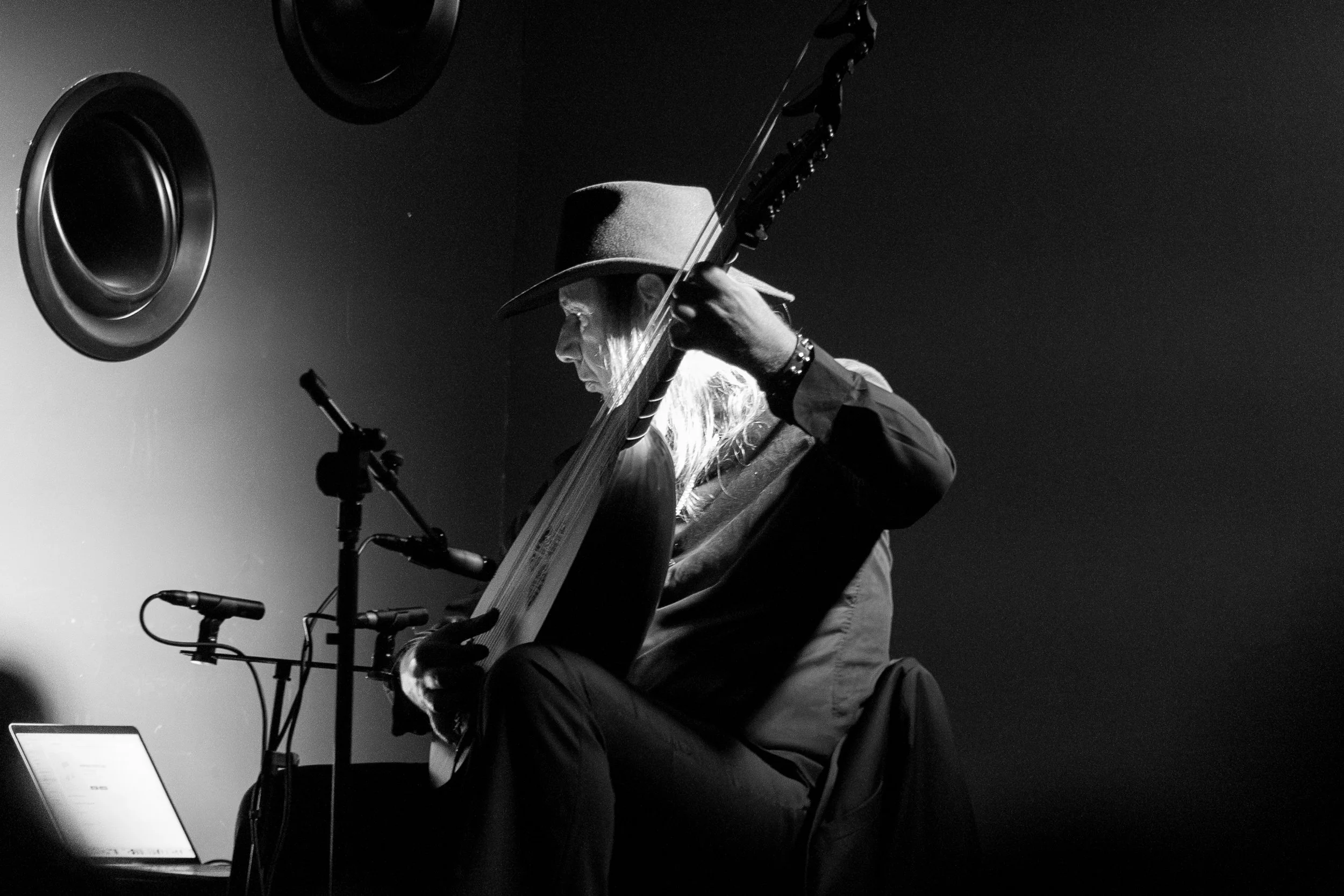
Photo credit: Alina Jarosi
V: Where do they come from?
J: I have no idea where it comes from. It's sort of like you recognise something, you recognise a language and then adapt it, it's right there. It's immediately there.
So you have to be in a certain state to do this, which is sort of hypnotic. This is writing to me. I try to be really secluded when I do that, just me in a room and nothing else. No internet and nothing for, say, two weeks or so, and then there's a group of pieces that becomes a record, and it's always like that.
It's always a document of a period. It's not like, “Okay, I'll write something now and then I'll write something again,” because that doesn't work for me. That's why these records have a very distinct vibe.
V: Do you wake up in the morning and just compose all day, or do you do it at night? What's your preference?
J: I can write like that when I'm in that state, it's something I really make myself do. Like writing slow bass pieces with a lot of space between the notes, for example. You know, the
first piece Act 1, from Nosferatu is like that. There's a lot of space in it, and I can only compose like that in the morning when I'm completely empty. On my new record “This Is My Blood” the first and last pieces are like that but I add slide to it.
V: I've read that you found this vinyl on the street with extinct bird sounds on it, and you used it for Nosferatu. I was thinking that again, that's quite similar to using voices and sounds that no longer exist and probably never will. Horror itself.
J: Yeah, but then conserving it is good.
V: Yeah, but it adds something eerie to the whole thing.
J: Yeah, yeah, that's about it. There's a scene in Nosferatu where the actor is reading a written text which mentions “The Call of the Deathbird.”
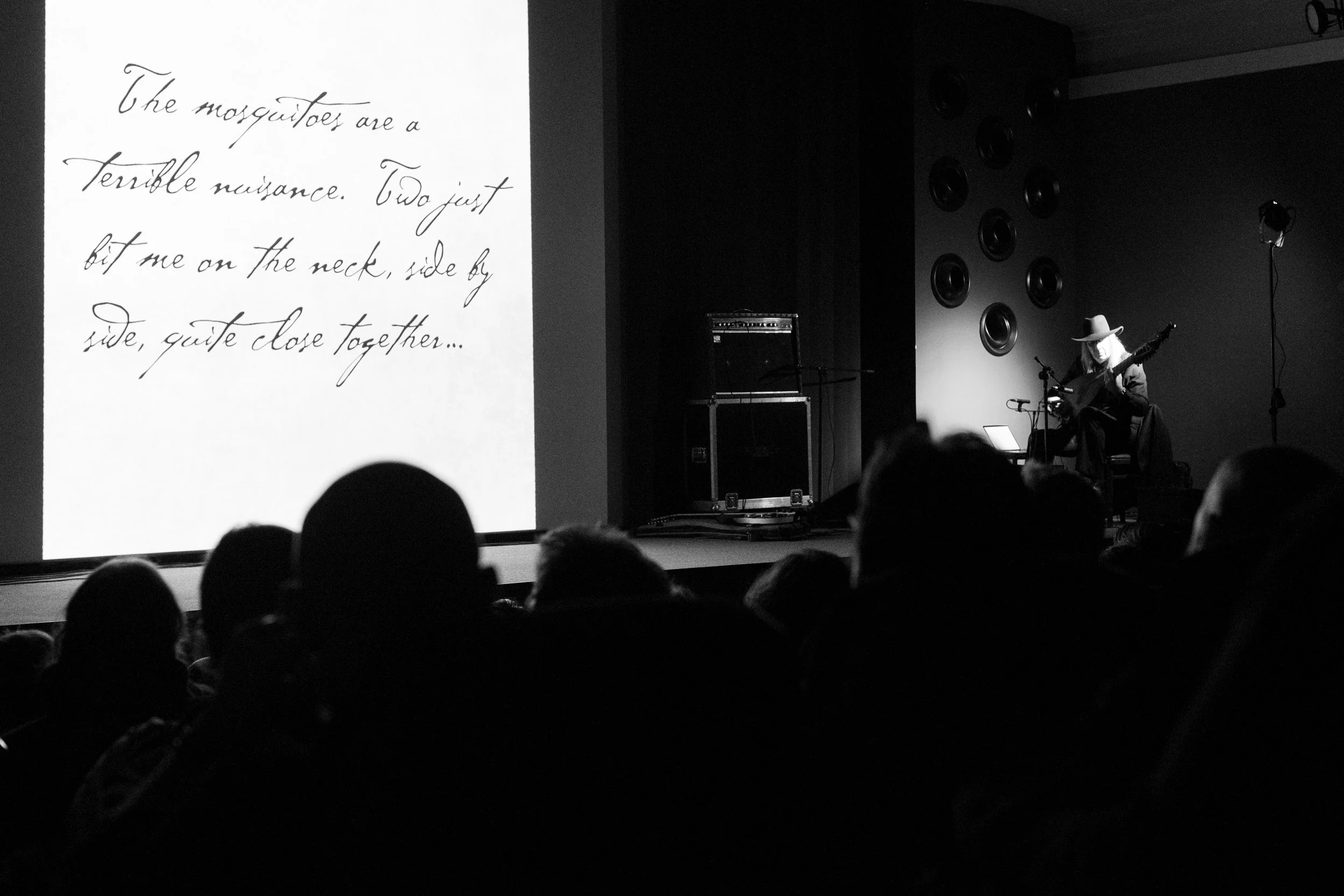
Photo credit: Alina Jarosi
V: I wanted to ask you about Only Lovers Left Alive. To me, it feels like craftsmanship and meaning and depth are dying out. Maybe I'm dramatic, but this is how I feel. And the main character, Adam, is suffering because of this, because he can't bear to live in like this. I wondered if you feel this too, being a lutenist in this century is sort of like a rebellion against everything.
Look at this furniture. [mass produced, mdf light grey fittings with bight, cold lighting, the ed.] Do you feel this sort of devastation that things that we like, our world, is diminishing, and you're trying to keep it alive?
J: Obviously, I feel the same way about that. I can see that. Things disappearing, like birds disappearing or species disappearing. It makes me sad.
V: Also, I'm not sure if I interpreted this right when I was reading some of your other interviews. Is it true that you don't obsessively watch the movie whilst composing?
J: Yeah, there's a reason. I don't think it's a good idea because that's sort of reactive, and I don't want to be reactive. I want to tell my own story. I think the music should come first and tell its own story. Because if you have a musical part under the film telling its own story it makes for a more layered work.
And if you react to the images, then it's a bit like a monkey reacting to images, which is not so interesting. I think that I try to write more to the personality of the director. Also sometimes I give the director directions like: put this in the most intense scene, put this in a dialogue scene, or put this in a landscape scene,” which works really well.
It's weird, the less there's discussed about where it should be or what it should have to be the better. Not like some producers are saying, “We want this and this,” or they give you Spotify playlists, God forbid.
V: How would you react to that?
J: Look at the syntax of the 1970s, where artists had complete freedom on the movies. Now they give you a Spotify playlist or your own music, which is a mindfuck. That doesn't work.
V: It's almost like soundtracks are becoming Foley.
J: Well, they all sound the same in the end, all these soundtracks for all these contemporary films. They all sound the same because the producers think they can get their money back they have invested “Oh, this was successful before, so let's do it again.”
V: You have two albums coming out on the 6th of November. Can you tell me more about them?
J: Last year we did three shows in the USA, one in Chicago and two in New York. We rehearsed in New York, Jim and I, and then there was a screening of Only Lovers in Bologna at this place for 5,000 people, in this square, at a Bologna Film Festival. They gave us a studio for a week, and these two records are the result of that.
V: Do you prefer to work collaboratively with people, or are you a lone wolf?
J: I like both. Well, it's really two completely different things. I like to work with Jim because we have this history, which is interesting to me. I don't like to play or improvise with people for one time or one record because it doesn't go anywhere. There is no developing story that way. Also I’ve known him for a long time, so it's interesting to see where it goes. He's a good friend. He works differently. I'm very short with decisions. It's like, “This works on this, and this doesn't.” And I guess he would try longer to see if there were different possibilities to do an idea.
You know, I write only a few notes. It's like, the other day somebody asked me, “Who's your favourite writer?” I said, “Well, if you compare it to my music, I would say Bukowski,” Bukowski puts lot of information in as few words as possible... I try to put a lot of information in three notes…
V: You said that because that's how you see yourself, but I'm not sure if other people see you that way.
J: Well, that's the way I feel it. I don't know if other people think differently.
V: What do you think about production? You know, the way I see it is that music is being overproduced. Vocals have to be pristine, crisp, clear. Nothing can be out of tune or microtonal, nothing can slide or be slightly out of time.
J: What I think about that is that you've arrived at the point now of what makes these times horrible, is that almost everybody now uses AI. Now is the time to be making mistakes in music and being off and being out of tune. But that goes against their shit, you know. Here is a musician that is human, that can make human error, and there is the perfect technical rendition. So what do you choose?
V: So you're not a gear snob? You don't need Abbey Road Studios?
J: No, that doesn't work for me. Anyway, I have a very personal way of recording. Also the way I like the sound of the instrument. There's not many people who know how to record it because I have a signature sound almost, in the placement of the mics as well, and all the effects and the instrument, the way the instrument sounds.
I had my lute builder built extra reverb in the lute, which is really difficult. The inside looks like a boat and there's a certain amount of ribs that make that sound. The tones inside are called wolf tones. So it's a very esoteric thing. Not many people know this.
V: Does it matter what kind of room you're recording in?
J: It does, it does. I have my room in Holland where it has a high ceiling, although I also have a place in Warsaw where I record. It's an apartment with very thick walls, which I really like, so you don't hear anybody. I love it, silence.
V: Well, I think you're allowed to sometimes, when they're being loud and unnecessarily there. There is a sense of the sacred in your music, but also something quite physical and sensual. Do you see spirituality and eroticism as opposing voices or complementing each other?
J: Not as opposing voices no.
V: I think people are often very sure about things, and what I'm learning is that you can't really be sure of anything other than one thing, which is that everybody dies.
J: Music is a way to deal with all that stuff for me. Maybe that's the answer to your question.
And when you play, it's also inclusive of all these things that we talk about, if it's spiritual or if it's just a way of psychology dealing with stuff. Because it can also be, if you do this for a while, if you tour for months, you can go completely nuts. You get mental. Just too much energy goes, and you just end up being mental.
But the show itself, the hour that you're up there, it's like the perfect therapy.
V: They say it unburdens your soul. It's a release.
J: Yeah, that's what it is. So that's the beauty of making music and maybe also listening to it.
V: It gives you an identity, doesn't it?
J: You know, I think what you said, for example, about Joy Division, when I heard that for the first time and I was twenty, I thought, “This is what I live for,” because you recognise this thing and it's so strong, and it gives you an identity, gives you a reason to be.
Hoping that other people will find you. It will seclude you from people who don't have that, so that means that you have strength and you have spiritual strength. You know, you have things, something that makes you stand out from the other people who don't have this.
And this is what's the great thing about this thing, whether it be goth or whatever, is that even if it's a dark thing, if you say, “Oh, here comes the vampire,” it doesn't matter. It gives you a reason to be...
You should check out these medieval writings by these nuns There's a book series called Classics of Western Spirituality. Less-known writers from that time, from this German monastery in Helfta.
V: Thank you. It's also interesting how religious people or society really reject the idea of occultism or hereticism or spiritualism, as in, “Oh, it's the devil,” when really they intertwine so much. The rituals, the sacrifice, blood, wine and so on. Lots of the prayers come from pagan or older rituals, and tarot cards and divination. Loads of religious people use it
I read a lot about the history, about how witches were prosecuted and it's still like that really. Yeah, you don't even have to be a witch, you just have to be a smart woman or different. It shouldn't be like that.
V: Do you sense a difference in Central/ Eastern European audiences compared to American audiences?
J: Yes, I do. I like the vibe, and the audience is really great here because for them it's really special if you play for them, you know. Like we talked about identity, that is bigger in the East than in the West, because in the East a musician can be political just by being there and performing.
When I used to go to Russia or Ukraine, for the audience it was a real deep experience to come to the show. It made them stronger.
V: There is a difference between the people and the system they grew up in. Both of my parents were artists in the eighties, and they were telling me that their shows got raided by the police. So you couldn't sing anything remotely suggestive of anti-government sentiment, because you got jailed. Everything is political. Do you ever write about things like this?
J: I don't write about politics, like I said. I like to be political just by being there and performing a certain way... For example, if I went to Ukraine and I played in this church and people would close their eyes and listen deeply. It's like religion to them.
I am being myself and show a way of being, I show a certain freedom to people.
V: How come you don't live in America?
J: Why don't you ask me how come you don't live in Russia?
V: So it's a conscious choice?
J: It's not only that. It's also that Europe is far more interesting. Eastern European, Slavic countries are far more interesting in terms of culture, in terms of history. There's your answer.
V: And they look better in the winter. Nice buildings look good in the fog.
J: Yeah, it's true. Older and better.
V: So what's your plan? Are you going to different countries? How long is your tour?
J: I am doing a longer European tour for my new release This Is My Blood next year. I'm also working on films, and I got that new instrument, which I'm very excited about.
The re-entrant tuning is a little bit like a guitar, but then there's the bass strings that go all the way down. It's very deep sounding and it's huge. It has microphones built in, which is sacrilegious to the early music community. They hate it.
V: Is that the two-metre one?
J: Yeah. It's all black and it has my initials engraved in the neck, but it also sounds beautiful. It’s a different tuning. Anyway, I'm looking forward to that, plus I'm doing another movie.
V: Can you tell me what it is?
J: Oh, no, not yet. I just finished one also called Màquina by Joaquim Pujol, which is getting distribution now, a road movie which was very nice to do. And I played these Bottleneck pieces that are on my last record, so I add slide lute sound to images of the Colorado desert.
Don't try it at home.
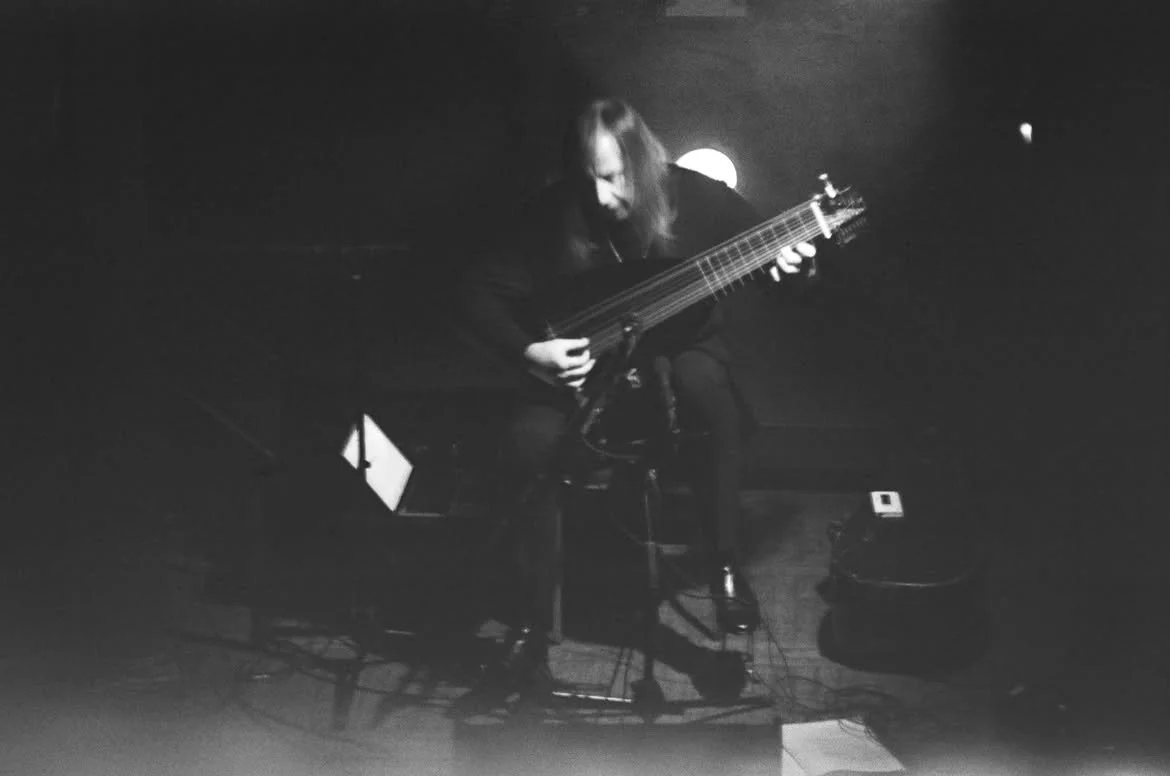
Photo credit: Arian Gharehbaghi